
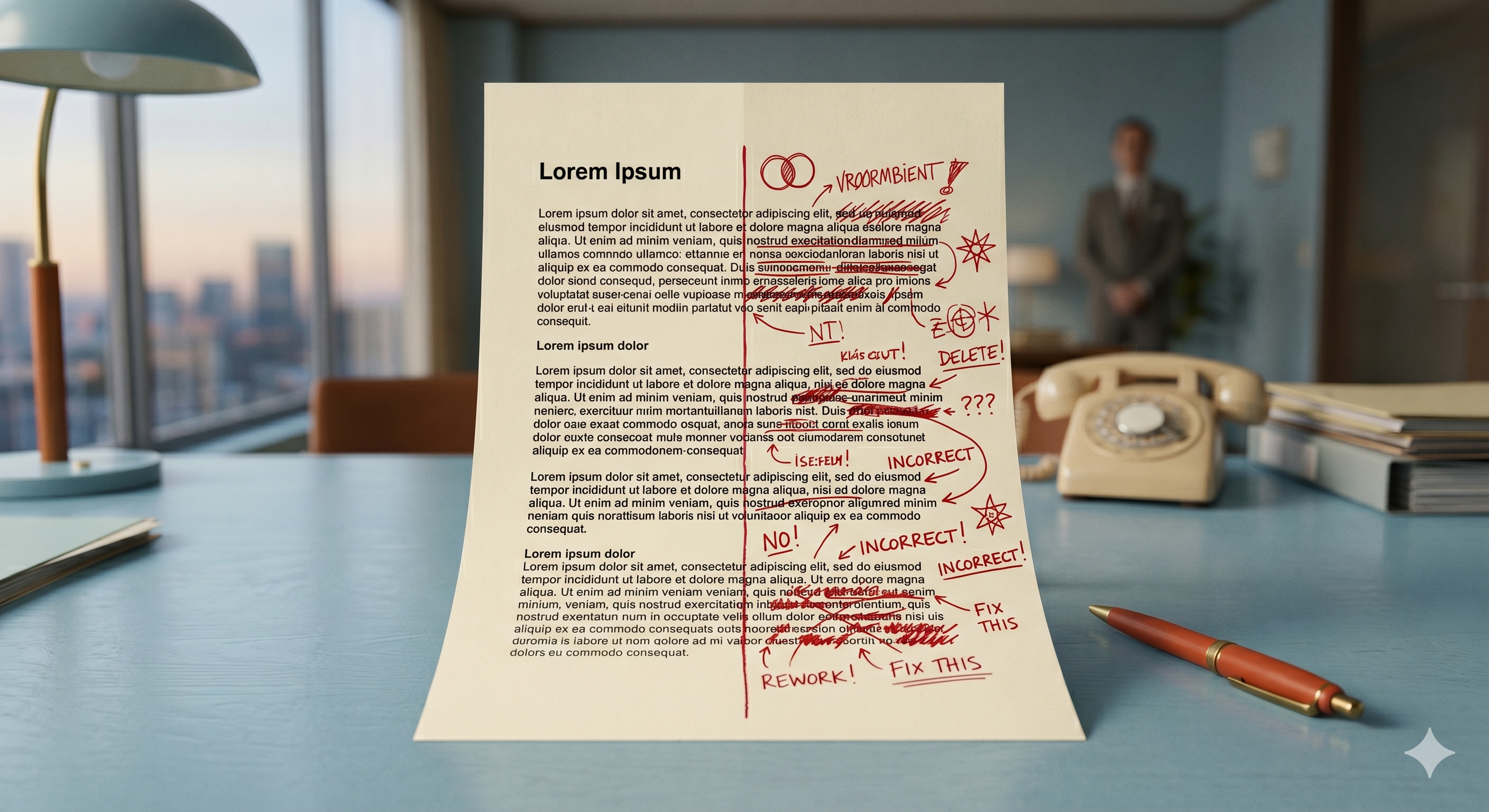
Read this first.
In today’s rapidly evolving business landscape, a groundbreaking new analysis from Barron’s has unveiled a startling trend that should serve as a wake-up call for corporate communications teams everywhere. According to the report, which leverages AlphaSense’s comprehensive document library, the telltale phrase “It’s not just a ___, it’s a ___” has seen its usage double twice since 2024 — skyrocketing from approximately 49 instances in 2023 to a staggering 208 in 2025.
But here’s the thing: this isn’t just a story about AI adoption. It’s a story about what happens when organizations fail to harness AI’s transformative potential responsibly.
With 92% of Fortune 500 companies now leveraging OpenAI’s tools, the question isn’t whether corporate America is using AI — it’s whether they’re doing so thoughtfully. The data suggests that many are not. And as AI continues to reshape how businesses communicate, those who fail to navigate this landscape with intention risk losing the authentic voice that sets them apart.
That’s ChatGPT. I gave it the same facts I’m about to give you and asked for a blog post opening. I didn’t edit what came back. Every tell is there. “In today’s rapidly evolving business landscape,” the single most recognizable AI opener, and one I’ve shipped before too. “Groundbreaking.” “Wake-up call.” “Leverages.” “Skyrocketing.” “Staggering.” “Harness.” “Transformative.” “Navigate this landscape.” And, with no prompting from me, one perfect instance of the very phrase Barron’s is measuring: “this isn’t just a story about AI adoption. It’s a story about…”
Now here’s the version I’m actually publishing.
Barron’s just quantified something that’s been sitting in everyone’s inbox.
They ran a search through AlphaSense, the same platform banks and investment firms use to comb press releases, SEC filings, and analyst call transcripts. They were looking for one specific phrase: “It’s not just a ___, it’s a ___.” The rhythm you already recognize. The one that sounds wrong when you read it out loud but somehow keeps showing up in your CEO’s shareholder letter.
Filings using the phrase, by year:
- 2022: ~46
- 2023: ~49
- 2024: 100 (doubled)
- 2025: 208 (doubled again)
Doubled in 2024. Doubled again in 2025. And because the pattern is so predictable, ChatGPT itself wrote the pull-quote Barron’s printed: “This analysis is not just a study — it is a wake-up call for corporate communications.” Read it out loud. The phrase mocks itself.
The obvious read is that corporate America got lazy. But laziness isn’t the mechanism, and once you see what is, you’ll understand how your own writing lands.
92% of the Fortune 500 already uses OpenAI
That number comes from OpenAI’s own disclosures. Ninety-two percent. So AI use cannot be what AlphaSense is detecting. If it were, the phrase would show up in almost every document they scanned, not 208 of them.
What AlphaSense is detecting is a subset. The subset of companies using AI and not editing afterward.
That’s the tell. Not AI. Unedited AI.
Which means the correction isn’t “use AI less.” It’s “edit harder.” And the reason most people don’t edit harder is that they can’t hear the tells in their own writing. The phrases sound fine because they’ve read ten thousand other pieces of corporate communication that use the same rhythms. Familiarity feels like fluency. It isn’t.
The same audit, on my own archive
I write a blog about AI strategy. I use AI to help me think, outline, and pressure-test. If this is a fair measurement of anything, it should apply to me.
So I ran the same vocabulary scan AlphaSense ran, just against my last ten published blog posts instead of the S&P 500. Thirteen thousand three hundred and eight words. Here’s what came back.
The Barron’s phrase, “It’s not just a X, it’s a Y” and every close variant:
- Count: 0
Corporate-AI vocabulary, the full scannable list. Words and phrases that came back with zero hits across all 13,308 words:
- delve, delving, delves
- showcase, showcases, showcasing
- robust
- unlock, unlocks, unlocking
- seamless, seamlessly
- realm, tapestry, in today’s
- harness, harnessing
- pivotal, paramount
- groundbreaking, revolutionary, revolutionize
- synergy, synergies, holistic, bespoke
- cutting-edge, state-of-the-art, at the forefront
- intricate, myriad, underscore
- transformative
Words that came back with small counts:
- leverage: 1
- navigate: 4
- comprehensive: 3
Of roughly forty of the most-common corporate-AI vocabulary tells, thirty-seven came back empty. Three came back with small counts across 13,308 words. Those three are now on my personal “prefer-the-specific-verb” list, so the next audit catches them before publish.
I’m not showing you this to prove I write well. Writing well is not what the data shows. The data shows I edit. That’s different, and it’s the point.
Why editing is the actual skill
Here’s what happens when someone who understands their own voice uses AI:
- They write a draft or ask AI for one.
- They read it out loud.
- They notice that three sentences in a row sound like they were generated by the same pattern.
- They cut the weakest one, rewrite the rhythm, and replace the abstract nouns with specific verbs.
Here’s what happens when someone who doesn’t understand their own voice uses AI:
- They ask AI for a draft.
- They read it silently.
- It sounds like the other business writing they’ve read.
- They ship it.
The first process takes twenty minutes. The second takes three. The first one produces writing that sounds like a human with a point of view. The second one produces the 208 filings that showed up in Barron’s.
The tell isn’t whether you used the tool. The tell is whether you finished the job.
Why I actually edit this hard
One more thing worth saying plainly. I don’t write these posts to sell you anything. I write them because writing is how I figure out what I think. The draft is where the ideas take shape, and the editing is where the thinking gets sharp. If I ship an unedited AI version, I haven’t done the thinking yet. I’ve just published a summary of what an average person would say if asked the same question.
That’s why the tells matter. They’re not just aesthetic problems. They’re evidence that the cognitive work didn’t happen. Which means when you run the audit on your own writing and the tells come back high, the feedback isn’t “your writing sounds like AI.” The feedback is “you didn’t finish thinking yet.”
The audit prompt
Here’s the prompt I built after reading Barron’s. It runs the same vocabulary scan AlphaSense ran, plus checks for the rhythm tells that don’t show up in a word frequency count. I’m publishing it before I’ve used it for months because the methodology is straightforward and the data is fresh.
Copy it. Use it. Tell me what it misses.
The AI Tell Audit
You are editing a draft for a writer who wants to keep their own voice and remove every trace of generic AI phrasing. Run the following checks against the text below and report back in a structured format.
1. The Barron’s phrase check. Count every instance of “It’s not just a X, it’s a Y” and every close variant (“This isn’t just,” “That’s not merely,” “Not only X but Y” used as a rhythm tell). For each hit, quote the sentence and propose a rewrite.
2. Corporate-AI vocabulary. Flag every instance of: delve, showcase, robust, unlock, seamless, leverage, navigate, navigating, transformative, realm, landscape, harness, pivotal, paramount, groundbreaking, revolutionize, synergy, holistic, bespoke, cutting-edge, state-of-the-art, at the forefront, in today’s, comprehensive. For each hit, propose a specific verb that names the actual action.
3. Rhythm tells. Flag three-short-sentences-in-a-row runs that don’t earn their place. Flag “Here’s the thing” and “The real X” openers. Flag any paragraph where every sentence starts with the same construction.
4. Abstract-noun openers. Check the first sentence of every paragraph. Flag any that have an abstract noun as the subject. Propose a rewrite with a concrete subject (person, action, number, object, or a direct question).
Report format: one section per check. For each flagged item, quote the original, name the tell, propose a rewrite. Do not rewrite the whole draft. Do not be gentle — the writer wants every tell surfaced, even minor ones.
Draft: [PASTE YOUR DRAFT HERE]
Paste that into any decent chatbot, drop your draft under it, and read what comes back. The list isn’t exhaustive — there are AI tells it won’t catch, sentence-length variance and certain transition patterns among them. But it catches the high-frequency ones, which is where most unedited AI gets exposed.
What this means for your own writing
The Barron’s finding is an unintentional gift to anyone who cares about their writing. Because now you have something you didn’t have before: a specific, tractable list of patterns to check for. The tells aren’t mysterious. They aren’t subjective. They can be counted.
Run the audit on your last three pieces of writing. If the numbers come back near zero, you’re editing. If they don’t, you now have a specific list of what to fix.
The 208 companies in Barron’s sample weren’t punished for using AI. They were punished for not finishing the work. The ones who edit disappear from the dataset entirely.
Sources
- Matthias Bastian, “Corporate America’s favorite ChatGPT phrase doubled twice since 2024,” The Decoder, April 21, 2026.
- Barron’s, “AI corporate lingo: ChatGPT is reshaping how companies talk,” April 2026.
- Muck Rack, “The State of AI in PR,” 2026.
- OpenAI company disclosures, 2024.
Leave a Reply